BASIC CONCEPTS AND TERMINOLOGIES OF BIOLOGY
 | |||||||||||||||||||||||||||||||||||
Basic Concepts and Terminologies of BiologyThe Meaning of Basic Biological Concepts and Terminologies
Biology is derived from two Greek words, that is, bios which means life and logos which means study or knowledge.
So
biology can be defined as a branch of science which deals with the
study of life. The term biology can also be defined as a branch of
science which deals with the study of living things or organisms.
Biologist
A person specialized in the study of biology
Life
Life
means being alive or existing. Something is alive or existing if it
possesses life processes. The life processes are growth, movement or
locomotion, respiration, excretion, reproduction, sensitivity and
nutrition.
Organism
Organism is anything which has life. It is the other name of a living thing. Organisms are made up of cells.
Cell
A cell is a basic unit of living things. The cell has three main parts, cell membrane, cytoplasm and nucleus. Cells which make up plants are called plant cells and those which make up animals are called animal cells.
Some
organisms are made up of one cell. They are called unicellular or
single-celled organisms e.g. amoeba, euglena and yeast. Some organisms
are made up of many cells, they are called multi cellular organisms e.g.
animals, plants, and most fungi.
The Characteristics of Living Things
All
living organisms are capable of movement. Movement is the change of
position of the whole organism or just part of an organism. For animals
and unicellular organisms the movement is of the whole body. This is
known as locomotion. Most animals move about using legs, wings
or fins. Unicellular organisms such as amoeba, paramecium and euglena
use the locomotory structures pseudopodia, cilia and flagella
respectively.
In
plants only part of it may move towards different factors such as
light, water, gravity etc. They move by growing. Their roots grow down
in the soil and their shoots grow up into the air or towards a source of
light.
Irritability (sensitivity)
Irritability
is the ability of an organism to respond to a stimulus. Stimulus
(plural; stimuli) is anything that causes a response in an organism.
Examples of stimuli include: an alarm clock, a smell of breakfast cooking and a fly landing on your skin.
All
living things are sensitive to certain changes in their surroundings,
that is, they are aware of what is happening around them. This is
possible because they have special organs known as sense organs by which
they detect these changes.
Examples of sense organs include: eyes for vision (sight); skin for temperature, touch, pressure detection; tongue for tasting; nose for smelling; and ears for hearing and body balance.
Plants do not have sense organs but are still able to detect and respond to things like gravity, water and light.
Feeding (Nutrition)
All living things need food to provide energy for such activities such as growth, repair and health.
Animals
get their food by eating other living things or food materials that
were once living things. Herbivores (e.g. rabbits) eat plants,
carnivores (e.g. lions) eat other animals, and omnivores (e.g. humans)
eat animals and plants. Plants make their own food through the process
called photosynthesis.
The process of taking in food, synthesizing it, digesting and oxidizing it to release energy or build the body is called nutrition.
Respiration
Respiration is the breaking down of food materials within cells to release energy.
Respiration
usually involves the use of oxygen. All living things need energy for
movement, growth and development, and functioning of body organs.
Excretion
All
living things produce wastes such as carbon dioxide, water, urea,
ammonia etc.. Some of these chemicals if left to accumulate in the cells
would seriously poison the living organism hence they need to be
removed. The process of removing metabolic waste products from the body
of living organisms is called excretion.
Waste products are removed from the body by excretory organs such skin, kidneys, lungs and liver.
Reproduction
Reproduction
is the process by which living things produce new individuals of their
own kind. All living things reproduce, to replace organisms lost by
death. If a group of organisms does not reproduce fast enough to replace
those which die, the group becomes extinct. Reproduction ensures
continuation of life when parent generation dies.
Human
beings bear babies; birds hatch chicks; and plants produce seedlings as
new organisms, which eventually grow to mature organisms to replace
those lost by deaths.
Growth
Growth
is defined as an irreversible (permanent) increase in size and dry
weight of an organism involving differentiation. All living things need
food in order to grow and build up their bodies.
Animals grow until they reach certain adult size, but most plants can grow continuously throughout their lives.
 A table showing the differences between livingthings and non livingthings
Branches of biology
Biology is a subject and it has many branches. The main branches are botany and zoology. Botany is a branch of biology which deals with the study of plants. A person who studies botany is called a botanist. Zoology is a branch of biology which deals with the study of animals. A person who studies zoology is called a Zoologist
Other branches of biology
Mycology: this is the study of fungi. A person who studies mycology is called a mycologist
Bacteriology: this is the study of bacteria. A person who studies bacteriology is called a bacteriologist.
Virology: this branch of biology deals with the study of viruses. A person who studies virology is called a virologist.
Immunology: is concerned with body defense against diseases and foreign substances. A person who studies immunology is called an immunologist.
Entomology: refers to the study of insects A person who studies entomology is called an entomologist.
Parasitology: this branch deals with study of parasites and their effects on living organisms. A person who studies parasitology is called a parasitologist.
Dermatology: It is concerned with medical study of skin and its diseases. A person who studies dermatology is called a dermatologist
Ecology: Is
a branch of biology that deals with relationship among living things
and between organisms and their surroundings. A person who studies
ecology is called an ecologist
Anatomy: Is the study which deals with structure of living things. A person who studies anatomy is called anatomist
A picture representing branches of Biology 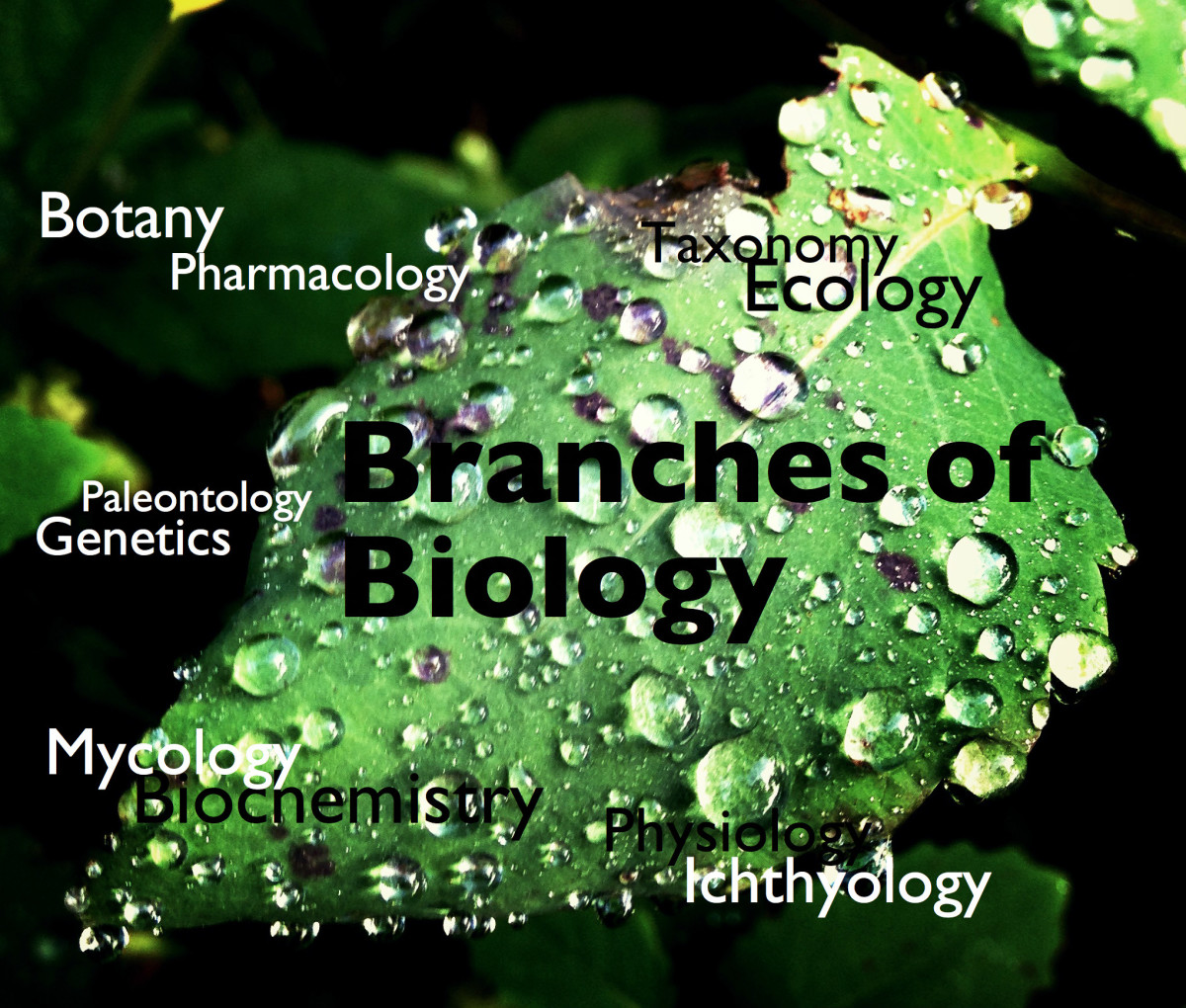 Endocrinology: This is the study of structure of endocrine glands and the hormones associated by them. A person who studies endocrinology is called an endocrinologist. Histology: Is the study of structure of tissues A person who studies histology is called an histologist
Cytology: Is the study of structure, composition and function of cells. A person who studies cytology is called a cytologist.
Microbiology: Is devoted to the study of organisms that can be seen only with a microscope e.g. bacteria, viruses, some fungi and some protoctists. A person who studies microbiology is called a microbiologist. Taxonomy: Is the scientific classification of organisms. A person who studies taxonomy is called a taxonomist. Genetics: Study of heredity and variation in organisms. A person who studies genetics is called geneticist. The Importance of Studying Biology
The following is an outlines of why the study of biology is important:
Relationship between Biological Science with other Related Fields
Veterinary science (Veterinary medicine)
Veterinary medicine is the branch of medicine that deals with the diseases of animals. Doctors that treat animals are called Veterinarians.
Veterinarians are trained to prevent, diagnose and treat illness in
large and small animals. Their work is valuable because many animal
diseases can be transmitted to human beings e.g. rabies, tuberculosis,
tularemia (rabbit fever) anthrax etc. Basic knowledge of biology is
required for successful study of veterinary science.
Agriculture
Agriculture
is concerned with production of useful plants and animals through
farming system. Agriculture provides us with almost all our food. It
provides materials for clothing and shelter. It provides materials used
for making many industrial products such as paints and medicines.
Agriculture uses knowledge of biology to improve plant and animal
breeding. Genetically modified organisms (GMOs) ensure better quality,
early maturity and high yield products. Crop and animal diseases and
pests can only be overcome by applying biological knowledge.
Forestry
A forest
is a large area of land covered with trees. It is much more than just
trees. It also includes smaller plants such as mosses, shrubs and wild
flowers. Forestry is the science of managing forest resources for human
benefit. The practice of forestry helps maintain an adequate supply of
timber and management of such valuable forest resources such as water,
wildlife, grazing areas and recreational areas.
Pharmacy
Pharmacy is the profession concerned with the preparation, distribution and use of drugs. Members of this profession are called pharmacists or druggists.
Pharmacy also refers to a place where drugs are prepared or sold The
drugs are made depending on the chemical composition of the body of an
organism and how they can react with such medicines. Knowledge of
biology also helps to know the effects of drugs on living things
(pharmacology) and possible remedies to be taken.
Medicine
Medicine
is the science and art of preserving health and treating illness.
Medicine is a science because it is based on knowledge gained through
careful study and experimentation. It is an art because its success
depends on how skilfully medical practitioners apply their knowledge in
dealing with patients. The goal of medicine include saving lives,
relieving suffering and maintaining the dignity of sick people.
Biological knowledge helps the doctors, surgeons and nurses to diagnose,
treat and prescribe the right medicine to cure the disease.
Biological
knowledge will also help them to offer education to the patients on how
to prevent themselves from the diseases e.g. purifying drinking water,
vaccination against polio, measles and other diseases.
Nutrition
Nutrition
is the science which deals with food and how the body uses it. People,
like all living things need food to live. Food provides substances that
the body needs to build and repair its tissues and to regulate its
organs and systems. Food also supplies energy for every action we
perform. Knowledge of biology helps to identify the type of food
required by an individual based on its quality and quantity.
A table showing differences between plants and animals
|

About EDUMOPA BLOG


