Origin and Evolution of Man

The Theory of Evolution of Man and the Religious Theory of Creation of Man
The Theory of Evolution of Man
The
story of human evolution began in Africa about six million years ago
and it describes the very long process that our ancestors went through
to ultimately become modern humans. This process has been uncovered by
studying fossils and understanding the underlying theory of evolution,
and while new fossils are uncovered every decade revealing new chapters,
scientists agree about the basic story.
Evolution
means the changes that occur in a population over time. In this
definition, a “population” means a group of the same species that share a
specific location and habitat. Evolutionary changes always occur on the
genetic level. In other words, evolution is a process that results in
changes that are passed on or inherited from generation to generation.
It does not, for example, describe how people can change their muscle
mass by lifting weights.
When
successful, these genetic changes or adaptations, which happen when
genes mutate and/or combine in different ways during reproduction, help
organisms survive, reproduce, and raise offspring. Some individuals
inherit characteristics that make them more successful at surviving and
having babies. These advantageous characteristics tend to appear more
frequently in the population (because those individuals with less
advantageous characteristics are more likely to die without
reproducing), and over time these changes become common throughout that
population, ultimately leading to new species.
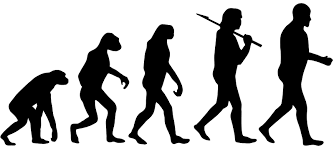
STAGES OF HUMAN EVOLUTION
Early man passed through main four stages namely: Modern apes, Australopithecus Africanus, Homo eractus and Homo sapien
1.MODERN APES
- This is the first stage of man's evolution, it is sometimes called pirmates.It consisted of Gorillas and Chimpanzee.
These creatures had the following characteristics:
- He walked on all four limbs
- He ate flesh and fruits
- He had long teeth
- He used four limbs as arms
- He hunted and gathered
2.AUSTRALOPITHECUS AFRICANUS
These creatures are divided into two:
- Zinjathropus
- Homo habilis
Their
fossil were first excavated in South Africa and the late fossils of
these creatures were discovered at Olduvai Gorge in Tanzania and they
were close to those of modern man. Australopithecus Africanus started
12,000,000 BC when primates changed near to man.
Zinjanthropus
Characteristics of Zinjanthropus were as follows:
- They had grinding teeth
- They were short
- They had low forehead and deep set eyes
- Their bodies were hairy
- They had small brain capacity which was a third of a modern man
- They walked on upright posture
- They made tools which were simple stone tools which they sometimes used them for protection against other animals
Homo Habilis
The
skull of Homo habilis was excavated at Olduvai Gorge in Tanzania and
at Koobi fora near Lake Turkana. Homa habilis means "handy man or with
ability or practical man"
Man at this evolution stage had these cultural and physical characteristics:
- He used his hands to grasp objects
- He had large brain capacity
- He made useful tools from stones and sticks
- He hunted and gathered
- He resembled man than apes and hence he is regarded as man ancestor
- He communicated through elementary language and lived in Africa for about one and a half million
3.HOMO ERACTUS
Homo eractus is also reffered as upright man.He was more man than apelike,his remainings were excavated in Ethiopia.
The following were his physical and cultural features
- He had upright walking posture
- He was more inteligent than the early man
- He had higher brain capacity ,1000CC
- He was able to make stone and bone weapons
- He painted pictures on the walls of his caves
- He learnt how to make fire
- He developed speech
- He hunted and gathered
4.HOMO SAPIEN
This
is the highest stage in the evolution of man.It took place 50,000
BC.Homo sapien means "thinking man".He used advanced tools like
chisels.Homo sapien lent to make better tools by use levalois techniques
and later developed industry.He existed during the new stone age
The following were the physical and cultural features of man during homo sapien stage:
- He farmed and keep livestock
- He caltivated
- He burnt the dead
- He settled in villages
- He began fishing
- He developed state organization on government
- He started religion
- He began simple industry which made beads out of bones and egg shell also pottery, busketry and painting
- He made better clothes from skin by knitting them with bone needles
- He built huts made of hatch and mud
WHY EARLY MAN MADE TOOLS AND WEAPONS?
- For defence against other wild animals
- For hunting and gathering for example animals and fruits respectively
- For cultivating especially during the new stone age when he domesticated plants
- For exchanging with other items
- Due to curiosity of finding up things

About EDUMOPA BLOG


